from Musician Biography!

Kurt Cobain Biography


Kurt Donald Cobain was the leader of Nirvana, the multi-platinum grunge band that redefined the sound of the nineties.

Cobain was born on the 20th of February 1967 in Hoquaim, a small town 140 kilometres south-west of Seattle. His mother was a cocktail waitress and his father was an auto mechanic. Cobain soon moved to nearby Aberdeen, a depressed and dying logging town.

Cobain was for most his childhood a sickly bronchitic child. Matters were made worse when Cobain's parent's divorced when he was seven and by his own account Cobain said he never felt loved or secure again. He became increasingly difficult, anti-social and withdrawn after his parent's divorce. Cobain also said that his parent's traumatic split fueled a lot of the anguish in Nirvana's music.

After his parent's divorce Cobain found himself shuttled back and forth between various relatives and at one stage homeless living under a bridge.

When Cobain was eleven he heard and was captivated by the Britain's Sex Pistols and after their self-destruction Cobain and friend Krist Novoselic continued to listen to the wave of British bands including Joy Division the nihilistic post-punk band that some say Nirvana are directly descended from in form of mood, melody and lyrical quality.

Cobain's artistry and iconoclastic attitude didn't win many friends in high school and sometimes earned him beatings from "jocks" Cobain got even by spray painting "QUEER" on their pick-up trucks. By 1985 Aberdeen was dead and Cobain's next stop was Olympia. Cobain formed and reformed a series of bands before Nirvana came to be in 1986. Nirvana was an uneasy alliance between Cobain, bassist Krist Novoselic and eventually drummer and multi-instrumentalist Dave Grohl

By 1988 Nirvana were doing shows and had demo tapes going around. In 1989 Nirvana recorded their rough-edged first album Bleach Bleach - CD-Albumfor local Seattle independent label Sub-Pop

In Britain Nirvana received a lot of recognition and in 1991 their contract was bought out by Geffen, they signed to the mega-label, the first non-mainstream band to do so. Two and a half years after Nirvana's first C.D. Bleach was released they released Nevermind, Nevermind - Japan - Vinyl-AlbumNevermind - Vinyl-Album Nevermind - CD-Album a series of different, crunching, screaming songs that along with it's first single Smells Like Teen Spirit Smells Like Teen Spirit - CD-Singlewould propel Nirvana to mainstream stardom.

Smells Like Teen Spirit became Nirvana's most highly acclaimed and instantly recognizable song. Not many people can decipher it's exact lyrics but Cobain used a seductive hookline to hook the listener. Nevermind went on to sell ten million copies and make a reported $550 million (US) leaving Nirvana overnight millionaires. Cobain was shocked at the reception of his highly personal and passionate music repeatedly telling reporters that none of the band ever, ever expected anything like this. It quickly became obvious that the obsessively sickly and sensitive 24yr old was not going to cope well with the rock'n roll lifestyle. "If there was a rock star 101 course, I'd really have like to take it," Cobain once observed. Cobain fell into heroin in the early 90's, he said he used it as a shield against the rigorous demands of touring and to stop the pain of stomach ulcers or an irritated bowel. Through the touring and pressure Cobain continued to write his very personal acutely focused lyrics.

Cobain was distressed to find out that what he wrote and how it was interpreted could quite often be miles apart. He was appalled when he found out that Polly a heavily ironic anti-rape song had been used as background music in a real gang-rape. He later appealed to fans on the Incesticide liner Incesticide - Japan - Vinyl-Album Incesticide - CD-Albumnotes "If any of you don't like gays or women or blacks, please leave us the fuck alone." It was to no avail, Cobain found that as an overnight millionaire musician control was something he had very little of. Cobain also worried that his band had sold-out, that it was attracting the wrong kind of fans (i.e the type that used to beat him up.)

In February 1992 Cobain skipped off to Hawaii to marry the already pregnant Courtney Love. Later in the year Nirvana released Incesticide and in August Cobain had hospital treatment for heroin abuse. Shortly after Frances Bean Cobain was born. In early 1993 In Utero In Utero - Vinyl-Album In Utero - CD-Albumwas released into the top spot on the music charts. In Utero was widely acclaimed by the music press and it contains some of Cobain's most passionate work. In Utero was a lot more open than Nirvana's previous albums. Songs like All Apologies All Apologies - CD-Singleand Heart Shaped Box detailed aspects of Cobain's sometimes shaky marriage, other songs like Scentless Apprentice detailed the agonies and struggles of Cobain's experiences.

Nirvana embarked on a support tour and recorded and filmed an "unplugged" (acoustic) performance for MTV in November of 1993. Nirvana's choice to honour bands and people that had influenced them and Cobain's passionate and intense vocals especially on "Where Did You Sleep Last Night?"silenced many of their who had labeled Cobain talentless. Rumors circulated that the MTV Unplugged compilation would be Nirvana's last album and the band were splitting up.

Cobain was a gun fanatic and always had several in his possession or in various forms of confiscation. In the northern winter of 1993-94 Nirvana embarked on an extensive European tour. Twenty concerts into the tour Cobain developed throat problems and their schedule was interrupted while he recovered. While recovering Cobain flew to Rome to join his wife who was also preparing to tour with her own band.

On March the 4th Cobain was rushed to hospital in a coma after an unsuccessful suicide bid in which he washed down about fifty prescription painkillers with champagne. The suicide bid was officially called an accident and was not even made known to close friends and associates. Several days later he returned to Seattle. Cobain's wife, friends and managers convinced Cobain, who was still in deep distress to enter a detox program in L.A. According to a missing person's report filed by his mother Cobain fled after only a few days of the program.

Cobain was cited in the Seattle area with a shotgun. Days later on the 5th of April he barricaded himself into the granny flat behind his mansion, put a shotgun in his mouth and pulled the trigger. On Thursday April the 7th ~ two days after a medical examiner says Cobain shot himself and the day before his body was found police say Courtney Love herself was taken to hospital in L.A. for a drug overdose. Released on bail, Love checked herself into a rehab center but left soon after a friend called her the next day with news of Cobain's death.

Cobain's body was found when an electrician visiting the house to install a security system went round the back of the house when no one answered the front door and peered through windows. He thought he saw a mannequin sprawled on the floor until he noticed a splotch of blood by Cobain's ear. When police broke down the door they found Cobain dead on the floor, a shotgun still pointed at his chin and on a nearby counter a suicide note written in red ink addressed to Love and the couples then 19 month old daughter Frances Bean.

The suicide note ended with the words "I love you, I love you." Two days after Kurt Cobain's body was found about 5,000 people gathered in Seattle for a candlelight vigil. the distraught crowd filled the air with profane chants, burnt their flannel shirts and fought with police. They also listened to a tape made by Cobain's wife in which she read from his suicide note. Several distressed teenagers in the U.S. and Australia killed themselves. The mainstream media was lambasted for it's lack of respect and understanding of youth culture.

Nirvana : Smell Like Ten Spirit
READ MORE - Kurt Cobain Biography

Super Junior "SuJu" Biography


Super Junior (Korean: 슈퍼주니어), also known as simply SJ or SuJu (Korean: 슈주), is a thirteen-member South Korean boy band formed by SM Entertainment in 2005, masterminded by Lee Soo Man.

The group initially debuted with twelve members on November 6, 2005 with the single, “TWINS (Knock Out)”. The original twelve members are 이특 (Leeteuk - the leader), 희철 (Heechul), 韓庚 (Han Geng), 예성 (Yesung), 강인 (Kangin), 신동 (Shindong), 성민 (Sungmin), 은혁 (Eunhyuk), 시원 (Siwon), 동해 (Donghae), 려욱 (Ryeowook), 기범 (Kibum). The youngest member, 조규현 (Cho Kyuhyun), became a part of Super Junior on May 23, 2006. The Chinese member, Han Geng, was chosen among the 3,000 applicants through auditions held in China by SM Entertainment in 2001. Moreover, before the addition of their 13th member, they were simply a project group named SuperJunior05. With his addition, the “05” was dropped and Super Junior became an official band.

Super Junior also has four sub-units with three different concentrations. The first one, Super Junior K.R.Y, consists of Kyuhyun, Ryeowook, and Yesung, and focuses on singing ballad songs. The second, Super Junior T, consists of Heechul, Kangin, Shindong, Eunhyuk, Leeteuk, and Sungmin. Super Junior T focuses on singing trot songs, an old style of Korean pop music. The third, Super Junior M, is made up of Han Geng, Siwon, Donghae, plus two SM Trainees, Henry and Zhou Mi. Kyuhyun and Ryeowook were added later. They focus on singing Mandarin Chinese songs. The fourth, Super Junior Happy, is comprised of every member of Super Junior T except for Heechul, who is replaced by Yesung.
Super Junior’s third album, Sorry, Sorry, was released on March 12, 2009. The title single off the album, “Sorry, Sorry” was digitally released on March 9, 2009. In less than a week after preorders were announced, over 150,000 copies were pre-ordered. Sorry, Sorry was their first album to debut at #1 on the Hanteo Charts, and it sold over 29,000 copies the first day, defeating Seo Taiji’s record of 25,000. Promotions for the album started March 13 with the performance of “Sorry, Sorry” and “Why I Like You” on Music Bank. Two weeks later, “Sorry, Sorry” became the number one song of the week on the same program. During the group’s performance on music program Popular Songs on March 15, ratings went up to as high as 14%, the highest in recent years. From March to May, “Sorry, Sorry” collected a total of ten #1 awards with consecutive wins. On May 12, Super Junior released their new album “It’s You”. The music video for the song “It’s You” was released two days before schedule because it was leaked onto the internet with only 3 seconds missing so without any editing they released it. Three days later they released what they called “It’s You (Drama Version)”. A month later, on June 15, they released “It’s You (Dance Version)”. In the unedited and edited version Kibum only showed up in the beginning and a minute part in the middle of the videos. In the dance version Kibum again did not appear. Promotions for “It’s You” ended in early June so SM could promote SNSD’s new song. Super Junior is currently preparing for their Super Show tour. They will hold two concerts in Japan in August 2009.

Super Junior was also featured as one of the dance contestant groups on Randy Jackson’s ABDC(America’s Best Dance Crew

READ MORE - Super Junior "SuJu" Biography

L'Arc-En-Ciel Biography


Posted By : Arie Putra Lahatta

L'Arc-En-Ciel
In February 1991, tetsu and hyde, along with Hiro (guitar) and pero (drums), formed the band and named it after a film that tetsu had seen. After a year of gaining notoriety in their hometown of Osaka, Hiro left the band on June 12, 1992. pero soon followed on December 30 of that same year, supposedly to join up with his friend Hiro again. tetsu convinced his friend ken to quit his studies in architectural design and join the band. A new drummer, sakura, was recruited after tetsu saw him play. In 1993, the band released their debut album, Dune under the indies label Danger Crue, which was met with plenty of success and rose to number one on the Oricon indies charts.

This caught the attention of some major labels, so in 1994, they signed for Sony's Ki/oon division, releasing their second album, Tierra (Spanish for "Earth") that same year. Heavenly followed in 1995, and True, their first million seller, in 1996.

In 1997, sakura was arrested for heroin possession and quit the band. This became lowest point in the band's history. When news of sakura's arrest became public every ounce of Laruku's popularity was stripped. Just as they had reached a peak in their career, CDs were being pulled off the shelves, and any songs that were used as theme songs were quickly replaced. There was no evidence of the band's existence, and their next single "The Fourth Avenue Cafe" was indefinitely postponed and has never been released. Many believe that the whole incident was blown tremendously out of proportion.

L'Arc-en-Ciel was quiet for a little while, but they were not ready to give up. They continued to be featured on magazines, but as a three-man band L'Arc-en-Ciel. They then created a "L'Arc-en-Ciel cover band", "The Zombies", which was the three-man band L'Arc-en-Ciel themselves covering and making fun of their own songs. They also covered artists such as Marilyn Manson.

In 1998, they released their first single since sakura left 「虹」 (Niji — Rainbow). yukihiro was the drummer for this release, but was only listed as a support member. However, the band members were quickly impressed with his drumming skills and made him the official drummer not long after niji's release. L'Arc-en-Ciel was back, and what better way to prove themselves then by organizing a concert, aptly titled "Reincarnation"; this was the reincarnation of L'Arc-en-Ciel.

The first concert date of the new tour in Tokyo Dome had an attendance of 56,000 and sold out in four minutes, a Tokyo Dome record as well as a testament to their popularity. Their next album was Heart, in 1998, which, like their second major album "Heavenly" is seen as a transitional album: trying to forget the past, but also trying to maintain their originality and success.

L'Arc-en-Ciel released three more albums of new material during the next few years. Ark and Ray which were released simultaneously in 1999, and were the first Japanese albums to be released the same day in many different Asian countries. The release of Ark and Ray marked the high point of their career, with each selling over two million copies (no other release from the band managed to reach two million). Real followed in 2000, which was the last CD of new material for some time, although many more compilation and remix albums would follow. L'Arc-en-Ciel also composed several theme songs for various anime series, including DNA², Rurouni Kenshin, Great Teacher Onizuka, and Fullmetal Alchemist. They also created the ending theme song to the movie Final Fantasy: The Spirits Within.

After a while, however, the various members began working on various solo projects. hyde released several solo albums (as HYDE), ken founded Sons of All Pussys, tetsu started Tetsu69 and yukihiro played with Acid Android. The band seemed close to calling it quits.

In June 2003, Laruku came back to play a series of seven concerts in Tokyo called the "Shibuya Seven Days", and announced a new album for release in the following year. So, in February 2004, their first single in more than three years came out, followed by another one in early March. Finally, their long-awaited new album, Smile, was released on March 31.

Shortly afterwards, on June 2, 2004, the single 自由への招待  ("Jiyuu e no Shoutai") introduced "P'unk-en-Ciel", a partial change, for the first time on CD with "Milky Way". In the past, the band also played a P'unk version of "Round and Round" live.

On July 31, 2004, L'Arc-en-Ciel made their U.S. concert debut at Otakon 2004. Approximately 12,000 people attended the concert, which was held at a outside venue for the first time in Otakon's musical guests history, the 1st Mariner Arena located near the Baltimore Convention Center.

In 2005, the band released various singles, including "Killing Me" , "New World", and "Jojoushi", which appeared in their last album, Awake, released on June 22 with twelve tracks, including "Lost Heaven", the end theme for the Fullmetal Alchemist film.

In addition, the band will go on their "Asialive 2005" tour, and as the name suggests, the band will be performing in Korea and China as well as Japan. Japan's two concerts will take place at the Tokyo Dome. More information about "Asialive 2005" can be found at their official website at the bottom of this page.

On May 31, 2005, Tofu Records, Sony Music Japan's U.S. label, released the DVD of the Otakon 2004 concert.

On July 20, 2005 "Link" was released; also known as the opening theme of the film Fullmetal Alchemist, it was the first Laruku single after "Awake". This single also includes a new version of "Promised Land".
READ MORE - L'Arc-En-Ciel Biography

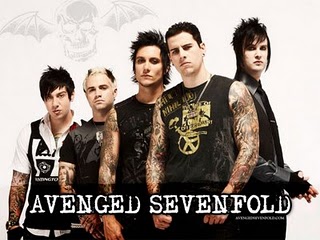
Avenged Sevenfold Biography


It’s not always recognized in today’s “I want it all now” world, but patience is a virtue. And Huntington Beach, California rockers Avenged Sevenfold are being rewarded for remembering that golden rule. After releasing two highly successful albums on an indie label (Sounding The Seventh Trumpet and Waking The Fallen), the quintet is set to unleash its major label debut, City Of Evil, on Warner Bros. Records. City Of Evil, co-produced by Avenged Sevenfold, reunites the group with producer Mudrock (Waking The Fall).

“We’re at the point now where we’ve come into our own,” vocalist M. Shadows says of the ambitious City Of Evil, an 11-song collection that gives a middle finger to the idea of categorization, bridging the sonic guitar assault of Iron Maiden with the frenetic pace of Bad Religion and the musicianship of Dream Theater. “In Southern California you’re really brought up in the whole punk world. At the same time, we were growing up listening to Pantera, Megadeath, Metallica and Slayer records,” Shadows recalls. “So then you think, ‘I want to play in that kind of band, but I want to play in this kind of band.’ Then you pass that point and all of a sudden you’re just writing music and it comes out naturally. But that’s what happens cause of all the different influences we have. And we’re definitely not afraid to put anything in our songs if we think it calls for it.”

Yes, Avenged Sevenfold can rock, as the band recently did at a sold-out show at Hollywood’s Music Box Theater, where they turned the intensity of the new tunes up from 11 to about a 20, but these are musicians as well. However, as the group evidenced during the orchestral interlude in “The Wicked End,” a perfect metal moment live complemented by a boys choir and 14-piece string section, Avenged Sevenfold, in the tradition of Zeppelin, Queen, and Guns ‘N’ Roses’ “November Rain,” meld their intensity with a musical daring their hard rock forefathers would be proud of.

Those looking primarily for a cathartic release live, as so many of the kids moshing their brains out at the Music Box were, need only turn to the ferocious energy of “Bat Country,” a song written for Hunter S. Thompson about the band’s own adventures in Vegas, and the Maiden-esque guitar and Shadows’ perfect caterwaul of the line “city of evil” (where the album’s title stems from) in the opening “Beast & The Harlot.”

And while Avenged, whose influences range from Maiden, Pantera, and Guns ‘N’ Roses (Shadows calls Use Your Illusions 1 and 2 his favorite albums of all time) to Billy Joel, Queen, and Elvis Costello, may not be your typical hard rock band musically, they can hang with the best of them. Epic nights of late night fun have followed this band around the country, and it’s something all of the members freely acknowledge. They like to party, and they like to drink: and plenty. Additionally, and fitting with their chosen lifestyle, the members of Avenged could write the A7X equivalent of the Zagut guide to strip clubs in America.

“Strippers and bands have this bond,” Vengeance says. “They totally do. The band walks in and it’s like special treatment,” Shadows adds. So, what makes a good strip club? “I like strip clubs that are out of control,” he says, citing Vegas, New York and New Orleans (“It’s fucking Bourbon Street. It better be crazy,” he says) as home to some of the better establishments they’ve frequented.

Reflecting the complex personalities though that can lead a hard rock band to throw in a beautiful Flamenco guitar solo near the end of the new album’s savage “Sidewinder,” Avenged Sevenfold is far from just a party band, and it shows on City Of Evil. The album is bursting with displays of their virtuoso musicianship, from the intricate tempo changes of “Burn It Down” to the tender acoustic intro into a Spaghetti Western mixed with classical melody that provides the calm before the storm in the savage “Strength Of The World.”

The group has learned a great deal having spent the last three summers as part of the Warped tour. Shadows got some valuable advice from Fat Mike of NOFX, besides how to play Texas Hold ‘Em. “He’s like, ‘You know what, if you do this stuff long enough, you gotta fucking have fun. If you can’t have fun on tour then you’ll never last,’” Shadows recalls. “I think that’s a really important thing.”

Additionally, the quintet, which started on a Warped side stage, graduated to the second stage, and then made the move last year to main stage, a spot they’ll be returning to this year, learned a lot by the gradual progression. “We’ve seen bands that we started out with that got a little bit of a head start or an early break and they’re done. We’ve learned so much more doing it from the ground up. We’ve got so many more stories than other bands will have; so many more good times, bad times. It has made us stronger as a band too,” Vengeance says.

Hard work is what also accounts for the band’s fiercely loyal following, according to Shadows. “It’s rewarding ‘cause you know you have this really solid core fan base that has been through a lot and they believe in the band now as more than a band, it’s like a lifestyle,” he says. “If anything happens we don’t ever fall, it’s like they’re holding us up. We’re not on the radio, but everywhere we go we always have this rabid group of fans. We would’ve never had that if we had some lucky break and just jumped to the point we’re at now. I hope it gradually keeps going up. The slower you go the more I think it builds underneath you and we’re grateful for that. They can’t just get pulled out from underneath us. There’s nothing you can grab to pull; it’s fans that love that band. So, it’s very gratifying to be at this place now.”
READ MORE - Avenged Sevenfold Biography

FORT MINOR BIOGRAPHY


FORT MINOR is the hip-hop side-project of Mike Shinoda, the vocalist, guitarist and songwriter of the alternative rock band Linkin Park. Shinoda's first solo album as Fort Minor, The Rising Tied, was released in 2005 with the singles "Where'd You Go" featuring Holly Brook and Jonah Matranga and "Remember the Name" featuring Styles of Beyond. Fort Minor Militia is the official fan club of the project, similar to Linkin Park Underground. Though it is technically a project by Shinoda alone, Styles of Beyond is heavily featured on "The Rising Tied" and appeared with Shinoda at photo shoots and live concerts.

History

Shinoda had been studying piano since 1993. Soon after graduating from high school in the mid-1990s, Shinoda joined drummer Rob Bourdon, guitarist Brad Delson, bassist Dave "Phoenix" Farrell, and DJ Joe Hahn to form the band Xero, renamed Hybrid Theory in 1998. The next year, singer Chester Bennington joined the musicians, who finally renamed the group Linkin Park. The band was signed to Warner Bros. Records in 1999 and released its debut album Hybrid Theory in 2000. In Linkin Park, Shinoda provided rap vocals in its hit singles "In the End", "Crawling", and "Papercut", and additionally keyboards for numerous other tracks. He also designed cover artwork for the band's albums. Hybrid Theory was nominated for three Grammy Awards and sold over 24 million copies. Around late 2004, Shinoda began recording his side project. The Rising Tied, the debut album of Fort Minor, was released in November 2005. Robert Hales directed its first video "Petrified", which was released the previous month. Jay-Z, who had previously collaborated with Linkin Park on the 2004 album Collision Course, was the executive producer for The Rising Tied. Shinoda told Corey Moss of MTV News that he imposed himself with a requirement to play all instruments and write all lyrics to his album except for strings, percussion, or choir parts. "Where'd You Go", its first single, peaked at #4 on the Billboard Hot 100 chart; following was "Remember the Name" at #66. Another track, "Kenji" describes the experiences of Shinoda's family during the Japanese American internment of World War II. Due to the success of "Where'd You Go", on the week of April 26, 2006, sales of The Rising Tied increased by 45 percent, and the album chart position went up 89 positions to #104 on the Billboard 200."Where'd You Go" was awarded Ringtone of the Year at the 2006 MTV Video Music Awards. In mid August 2006 Fort Minor performed at the Summer Sonic 2006 alongside Linkin Park. The third track on the album, "Right Now", is featured in the trailer of The Family That Preys by Tyler Perry. In November 2006, Fort Minor released a video for "Remember the Name", which features a montage of various amazing feats. Shinoda has stated he felt the video was a nice wrap-up for Fort Minor. Also in November, Shinoda stated that Fort Minor is on hiatus, because of his dedication to Linkin Park. In 2006, Holly Brook released an exclusive version of "Where'd You Go" to radio stations, made completely by Holly Brook. Mike does not appear on this version, which can be heard by request on various American radio stations.

Related Tracks

Move On (featuring Mr. Hahn)
Do What We Did (featuring Styles of Beyond)
Tools of the Trade (featuring Styles of Beyond & Celph Titled)
Start It All Up
Strange Things
READ MORE - FORT MINOR BIOGRAPHY

Black Eyed Peas Biography


The Black Eyed Peas are an American hip hop crew from Los Angeles, who have lately enjoyed massive international pop success. As Atban Klann, they signed to Ruthless Records (run by Eazy-E), but their album was never released because the positive and peaceful lyrics were too unusual for Ruthless. The group is composed of Will.i.am, Apl.de.ap, Taboo, and Fergie.

After Eazy-E died of AIDS in 1995 (see 1995 in music), Atban Klann reformed as the Black Eyed Peas and released a debut, Behind the Front (1998, 1998 in music) that earned the group (and their accompanying live band) critical acclaim. Their other album is 2000's Bridging the Gap (2000 in music). Their breakthrough album Elephunk was released in 2003, featuring a new female vocalist, called Fergie, born as Stacy Ferguson who used to be in a teen pop band named Wild Orchid. She is the replacement of background singer Kim Hill who departed the band during 2000.

From 'Elephunk' came the anti-war anthem 'Where Is The Love?', which became their first major hit, peaking at #8 on the US Hot 100, but topping the charts practically everywhere else, including six weeks at #1 in the UK where it became the biggest-selling single of 2003. The album subsequently spawned 'Shut Up', which failed in the US but peaked at UK #2 (despite being referred to by one reviewer as 'The single most vacuous, pointless, vile and generally loathsome song in a generation') and topped the charts in many other European countries including France and Germany. Indeed the band have enjoyed greater mainstream success in Europe than in the US with 'Elephunk' going Top 10, gold and (sometimes multi-)platinum in the UK, Germany and many other European markets, yet ultimately failing to break the US Top 10, although it did go platinum there. The third single from the album, 'Hey Mama' hit the Top 10 in the UK, Germany and several other European countries, and reached the Top 30 of the US Hot 100. Controversially, a reference to 'dropping bombs like we in the Middle East' was edited out of some versions of 'Hey Mama'.

The current line-up of the Black Eyed Peas as of 2004 (not including supporting band members) is: will.i.am, apl.de.ap, Taboo, and newcomer Fergie­.

During Black Eyed Peas' concert tour in Asia in 2004, Apl.de.ap's life story was featured in a weekly Filipino TV drama special called Maalaala Mo Kaya (Will You Remember), which explained his childhood with his poor family in Pampanga, Philippines, before sadly parting with them to live a better life in the US at the age of 14. The Apl Song, with the chorus written in Tagalog, from their album Elephunk, tells the story of Apl.de.ap. The Tagalog lyrics and backing melody were based on the the song Balita, an original composition of the 1970s Filipino folk rock group Asin.

The BEP's song 'Let's Get Retarded' was restyled as 'Let's Get it Started' for an NBA finals worldwide commerical. New lyrics gave the tune a basketball theme, and the spot featured Carlos Santana. The revised song had great success as a single, especially popular on the iTunes music download service.

READ MORE - Black Eyed Peas Biography

biografi The Lucky Laki


Kebahagiaan Ahmad Dhani semakin lengkap setelah dua anaknya Al dan Dul berhasil meraih Inbox Award lewat video klip lagu Munajat Cinta. Al (Ahmad Al Gazali) mendapatkan gelar sebagai model klip pria terfavorit, sementara Dul (Ahmad Abdul Qodir Jaelani) mendapat penghargaan adegan video klip terfavorit lewat akting memberikan bunga pada seorang cewek dalam video klip lagu The Rock tersebut.

“Yang penting di atas prestasi itu adalah kesenangan mereka, kalau mereka dapat prestasi tapi mereka nggak seneng sama juga bohong,” terang Dhani mengomentari prestasi anak-anaknya itu

Dhani juga meyakini bahwa anak-anaknya, merupakan anak yang kuat dan berprestasi meski tanpa dirinya. Karenanya Dhani tidak khawatir jika suatu hari jauh dari mereka.

“Saya tidak khawatir anak-anak ini, karena ada atau tidak ada saya, mereka itu anak-anak yang kuat. Anda lihat saja nama El Jalaluddin Rumi, nama anak-anak yang kuat. Karena itu anak-anak harus jadi yang kuat, dan yang tahu kekuatan mereka ya saya sendiri,” ungkapnya.

Pada kesempatan Inbox Award yang digelar di Senayan, Minggu (24/8) itu, El juga menunjukkan kemampuannya bermain gitar. Bahkan dalam waktu dekat, menurut Dhani ia akan bersama teman-teman seumurnya merilis band, yang diberi nama The King. Meski waktu pastinya masih harus menunggu, saat yang tepat.

“Dia memang suka main gitar, saya ajak dia tampil, dan juga anak ini anaknya kurang pede, malu-malu tidak seperti Dul, kalau ini over pede,” terang Dhani sambil menunjuk anak-anaknya.

Dengan kebahagiaan ini Dhani juga mengajak untuk melihat lagu Kamu-kamulah Surgaku, yang mencerminkan kebahagiaannya bersama anak-anak yang menjadi inspirasinya.

“Mungkin semua orang banyak aset, banyak kekayaan tapi nggak punya anak yang sehebat, seganteng, secerdas dan tingkat spiritualnya tinggi kayak anak-anak saya ini,” pungkas pentolan group musik Dewa 19.

READ MORE - biografi The Lucky Laki

Milli Vanilli Biography


Milli Vanilli. The mere mention of the name still calls up the same derision it did when the dance-pop duo's career came to a sudden and ignominious end: Fakers. Frauds. A blatant marketing scam. Their story has been retold countless times: after selling millions of records, Rob Pilatus and Fabrice Morvan were revealed to be models who publicly lip-synced to tracks recorded by anonymous studio vocalists. They became the first act ever stripped of a Grammy award and came to symbolize everything people disliked about dance-pop: it was so faceless that every musician involved could remain anonymous without anyone knowing the difference, so mechanical and artificial that the people who constructed it had to hire models to give it any human appeal, so pandering and superficial that people bought it just for its attachment to a pretty face. Whether that assessment was fair or not, it was beyond easy to hold Milli Vanilli in contempt. Yet for all the scapegoating, they were far from the only dance-pop act to be fronted by lip-syncers in the late '80s (the Martha Wash-voiced Black Box and C+C Music Factory spring to mind), nor were they the only Europop act to employ similar marketing tactics. (They were simply the most successful and visible, since their incorporation of rap made them more appealing to Americans.) What's more, pop music had a long tradition of hits recorded by anonymous studio musicians, dating back to '50s instrumental combos and '60s bubblegum. Milli Vanilli had the bad luck to get caught in a hoax during the extraordinarily image-conscious MTV era and a time when dance music of any stripe was accorded virtually no critical respect anyway, before its producers were perceived as the real creative points of focus. It's not as though Milli Vanilli were acclaimed for their honesty of expression before the scandal broke; it's more likely that what fueled the backlash was public resentment over Rob and Fab's celebrity (why should they be famous if they couldn't sing?) and embarrassment over the fact that Milli Vanilli's marketing had worked like a charm on everyone right up through the Grammy committee.

Milli Vanilli was the brainchild of German producer Frank Farian, who'd previously masterminded the European disco group Boney M. and the session-musician rock outfit Far Corporation. Seeking to fuse European dance-pop with elements of American rap, Farian assembled a number of session musicians and vocalists, including rapper Charles Shaw (an Army veteran) and two middle-aged American singers living in Germany, Johnny Davis and Brad Howell (some accounts give his name as Howe). Realizing that he had a marketable record but a distinctly unmarketable image, Farian hired two aspiring models and former breakdancers, Rob Pilatus and Fabrice Morvan, to pretend to be the group in videos, concerts, interviews, and the like. Pilatus had been born in New York in 1965, but grew up in Munich, spending some time in an orphanage after his parents (an American soldier and German stripper) gave him up for adoption. Morvan was born in 1966 on the island of Guadeloupe, lived in Miami for a time, and moved with his mother to Paris; he had been a skilled trampoline athlete until he suffered a neck injury in a fall. Both skilled dancers, the two had met sometime circa 1984 (differing accounts list their meeting place as Munich, Paris, or Los Angeles) and were attempting to make it as singers, dancers, models, or whatever they could. Their exotic look and long dreadlock extensions were just what Farian was looking for.

Milli Vanilli's first album, All or Nothing, was released in Europe in 1988 and was an instant success. Retitled Girl You Know It's True (after the lead single) and trimmed a bit, the record was issued in the U.S. in early 1989. Its catchy, lightweight pop-rap proved equally popular with American audiences; "Girl You Know It's True" raced up the pop charts to number two, and the next three Milli Vanilli singles -- "Baby Don't Forget My Number," the ballad "Girl I'm Gonna Miss You," and the Diane Warren-penned "Blame It on the Rain" -- all hit number one. Despite near-universal critical distaste (Farian's productions often recycled the same sounds and drum tracks), Girl You Know It's True sold an astounding seven million copies in the U.S. alone; internationally, Milli Vanilli sold approximately 30 million singles. In December 1989, as the fifth single "All or Nothing" was climbing the charts on its way to the Top Five, rapper Charles Shaw revealed to a New York reporter that Pilatus and Morvan had not actually sung any vocals on the album. Shaw quickly retracted his statements (apparently paid off by Farian to keep quiet), claiming that they were merely a PR stunt for his own album. Milli Vanilli was soon nominated for a Grammy award for Best New Artist, even though the rumors continued to swirl. And in early 1990, they won it, for the record beating out the Indigo Girls, Neneh Cherry, Soul II Soul, and Tone-Loc.

Success (or at least fame) was beginning to go to the duo's heads, particularly Pilatus, who was given to extreme mood swings and erratic behavior, and developed a cocaine problem. In an interview with Time magazine, Pilatus compared himself and Milli Vanilli favorably to Bob Dylan, Elvis Presley, Paul McCartney, and Mick Jagger, and was roundly ridiculed for his statements. Additionally, Pilatus and Morvan had been pressuring Farian to let them sing all the vocals on the next Milli Vanilli album. Exasperated with them, Farian exposed the whole scheme in November 1990 and the public was furious. Pilatus and Morvan were stripped of their Grammy (ironically, the committee had justified its vote by citing the duo's "visual impact"), and a class-action suit was filed against Arista Records, allowing anyone who believed they'd been defrauded into purchasing the group's records to apply for a rebate. Arista dropped the group and deleted Girl You Know It's True from their catalog, making it the biggest-selling album ever taken out of print.

In 1991, Farian attempted to re-form Milli Vanilli with the original session vocalists (including female backup singer Gina Mohammed), this time crediting them and billing them as the Real Milli Vanilli, while also adding a Pilatus/Morvan look-alike named Ray Horton. However, the resulting Moment of Truth album flopped. Pilatus, meanwhile, was unable to deal with the sudden fall from grace; after mixing alcohol and prescription drugs, he slashed one of his wrists in a Los Angeles hotel, then called police and reporters to the scene, where he had to be removed from the balcony he was threatening to jump off of. Attempting to prove that they really could sing if given the chance, Pilatus and Morvan regrouped in 1993 as Rob & Fab; however, with their credibility damaged beyond repair, their self-titled debut reportedly sold only 2,000 copies total, despite an appearance on The Arsenio Hall Show. Farian had also attempted yet another album, this time renaming his group Try 'N' B and retooling the lineup again to enhance its visual appeal (which meant discarding the original singers); however, Sexy Eyes also stiffed. From there, Pilatus hit rock bottom. Beginning in 1995, he was arrested for several separate incidents in Los Angeles involving assaults (including one man he attacked with a metal lamp base), vandalism, and attempting to break into a car. Convicted of four different misdemeanors, he was sentenced to several months in jail in 1996, and did the first of numerous stints in drug rehab centers for his cocaine addiction. Pilatus eventually returned to Germany; in April 1998, his body was found in a Frankfurt hotel room after he mixed a fatal combination of pills and alcohol. Morvan continues to pursue a solo career. Steve Huey, All Music Guide
READ MORE - Milli Vanilli Biography

Vertical Horizon Biography


Launched in 1991 as a folk-based acoustic duo, Vertical Horizon gradually molded itself into a slick pop/rock outfit, culminating in the band's brief (but significant) heyday at the turn of the 21st century. Matt Scannell and Keith Kane first performed together at Georgetown University, where the two undergraduates honed their harmonized vocals at parties and local coffeehouses. Shortly after graduation, they relocated to Boston to record a debut LP, 1992's There and Back Again, and returned to their native D.C. after the album's release. They later crossed paths with Jackopierce, another acoustic rock act, and the two groups soon launched a multi-week package tour that introduced Vertical Horizon to a wider audience.

Backup musicians were hired to fill out Vertical Horizon's evolving sound, and a tour alongside the Dave Matthews Band proved to be especially fortuitous, as drummer Carter Beauford -- a newfound fan of the band -- agreed to handle percussion duties on the sophomore effort Running on Ice. Bassist Sean Hurley and drummer Ed Toth were added to the lineup in 1996, thus making Vertical Horizon a permanent four-piece, and 1997's Live Stages captured the quartet's strength in concert. Such momentum wasn't lost on the major labels, and RCA ultimately offered the group a contract as the '90s drew to a close.

Vertical Horizon reissued its three previous LPs after signing with RCA, and the band's major-label debut, Everything You Want, followed in July 1999. The album went double platinum on the success of the title track (a number one hit) and three additional singles, and Vertical Horizon supported its release with a string of American and European tour dates. Although originally intending to issue a follow-up album in late 2002, the bandmates struggled with their representation at RCA, and ultimately left the label after Go's release in September 2003. A new contract was inked with Hybrid Recordings in 2005, but Toth left the band that same year, with the band continuing to work on a new release in his absence. Andrew Leahey, All Music Guide

READ MORE - Vertical Horizon Biography

Helloween Biography


Few bands get to the top and drop out so fast as Helloween. Their career is characterized by ups, downs, disappearances, new members, name changes and a lot of critics.

The band started in end of '70's (1978 to be precise), when Kai Hansen and Peter Sielck formed a band named Gentry, with some guest musicians. Two years later, they decide to invite two new members in the band: Markus Grosskopf on bassist and Ingo Schwichtenberg on drums. And with the new members they changed their name to Second Hell.

The band still wasn't satisfied with their new name, so in '82 they changed it again to Iron Fist. At that time, Kai Hansen was trying to bring a new guitarist to his project. It was Michael Weikath, who came from an unknown band named Powerfool. They then changed their name again and finally to Helloween.

After two years full of rehearsals and a few gigs, they were finally invited to record two songs for a collection named "Death Metal", which in spite of the name it had nothing to do with the style. They recorded "Metal Invaders" (their first hit) and "Oernst of Life". The second one was in fact an old composition from Weikath's last band. Recently this music was re-released in a double CD named "12 years in Noise", from their first label, Noise Records.

In their self-named first mini-LP, released in '85, the vocals were done by Kai Hansen, who also sang in their first album, "Walls of Jericho", But Hansen couldn't sing and play guitar at the same time, and they invited Michael Kiske to join the band. As everybody knows, this was the perfect decision, 'cause Michael Kiske's amazing voice and charisma got Helloween to the top all over the world.

With this formation, the band released their masterpieces, "Keeper of the Seven Keys Pt. I and II". But in the beginning of the '90's, they rann in to some serious problems First, guitarist/vocalist/mentor Kai Hansen left the band, alleging tours fatigue. Kai formed another band some months later, Gamma Ray. Then, Michael Kiske got involved with an obscure religion, and started a lot of misunderstanding with the other members.

But surely the worst episode happened with drummer Ingo Schwichtenberg, who had some schizophrenic hereditary problems. Before a show in Japan, he dropped on the floor and started to cry compulsively. While touring, he used to become very depressed, and then this was compounded by euphoric moments caused by cocaine use. Everybody knows how this story ended: Ingo commit suicide. With all these problems, it becomes obvious why the next few albums didn't have a good repercussion. The band started a fight with labels, and according to Weikath, Noise didn't paid then what they should have, EMI fired them, and even nowadays they are rumors they're having problems with Castle.

After overcoming all these problems, they invited Andi Deris to replace Michi's place and Uli Kusch (ex-Gamma Ray) to the play the drums. And so, with the current formation (Deris, Kusch, Weikath, Grosskopf and Roland Grapow) they released "Master of the Rings" and tried to get back to the top. In the last year, they released "The Time of the Oath", a double-live album named "High Live".

Now, in 1998, they have just released their lastest album, "Better than Raw", wich is considered the best since Keepers. The band stays the same for the happyness of the fans. Now we will have to wait for the next album until the next milenium...

Download :

Helloween - Forever and One

READ MORE - Helloween Biography

Pop Shuvit Biography


Pop Shuvit began making waves in the local music scene in late 2001. Comprising of Moots (vocals), JD (guitars), AJ (bass), Rudy (drums) and UNO (turntables), the band has had 4 successful releases under their belt and rocked fans throughout Asia notably in Japan, Thailand and Singapore. Known for their adrenaline packed live shows and eclectic blend of hip hop and rock, Pop Shuvit are being touted as Asia’s leading Hip Hop Rock band.


Their debut album ‘Take it & Shuvit’ broke new ground when their first single ‘Skaters’ Anthem’ was released exclusively on the Internet and became one of the most downloaded local songs in Malaysian music history. The hype and street buzz from the track caught the ears of ESPN, who in turn licensed the track for use in their Summer X-Games broadcast that hit millions of households worldwide. As further credit to Pop Shuvit, ESPN played their music videos and tracks off the album throughout the duration of competition.


In 2003, Pop Shuvit released “Take it & Shuvit” in Japan and became the first Malaysian band to hit the music chart in Japan. The overwhelming support from Japanese youth market ensured that all tracks of the album charted the top 20 on the Tower Records sales charts (even beating raprock luminaries like Linkin Park) without any promotion to back the album. The success of their releases in Japan led to Pop Shuvit touring the land of the rising sun in 2005 to support their sophomore release, ‘HERE & NOW’, leading to one of the most successful and talked about headlining tours for any Malaysian rock band. The album was a hard-hitting social commentary of urban culture and spurred hits like “Old Skool Rocka” and “Journey”, with the latter earning the band the 1 Song of the year on the Malaysian English Top Ten for 2005 and “Best Rock Act” at the inaugural Hitz.fm Malaysian English Top Ten Awards 2005.


Always one to go against the grain, the band released a dance remix album and a hip hop EP in 2004 and 2006 respectively. The remix of their track ‘Conversations’ from the “Shuvit Remixes” dance CD was hand picked by uber DJ Nick Warren for inclusion in pioneering UK dance music label Global Underground’s mix CD, Shanghai GU28 that peaked at 19 on the UK TOP 40 Dance Album Charts. The hip hop EP, a 4 track 12 inch vinyl release, featured collaborations with some of hip hop’s most respected emcees from around the globe including US emcees Big Pooh from Little Brother, L.E.G.A.C.Y, Cesar Comache, ZION from ZION I, Def Jam Japan’s DABO and Reggaeton duo Nitro Y Fanta from Puerto Rico.


Not resting on their laurels, Pop Shuvit’s eagerly anticipated third album, aptly titled “Amped & Dangerous” hit stores in Japan on 23 August 2006 with a later release date being planned for the Malaysian market. The 12 song set is a rollercoaster ride of crunching guitars, pounding rhythms and funked out hip hop beats and rhymes."This is essentially a guitar driven album that’s made for the mosh pit. Simply put, it rocks harder!” says skinman Rudy about the new material.Malaysian fans can expect something different as Guitarist/Producer JD hinted, “We had to think strategically this time around and only release tracks that cater for a specific market so the Japanese/Asian and Malaysian editions will be different.” The Japanese edition of the album will be released throughout Asia as an import edition so fans will still be able to obtain both copies.To top off a great 2006, Pop Shuvit walked away with the “Best Live Act” at the Annual Malaysian English Top Ten Awards 2006.Being independent, the boys understand that there is a need to diversify and take the band to the next level as frontman Moots! Pointed out, “That’s the essence of Pop Shuvit, we always do things differently and love taking risks. We want to turn Pop Shuvit into a brand name and to do this we need to branch out and spread our wings be it in music or other facets of urban culture.”


True to their word, the boys have done just that by setting up Shuvit Management and Studio 21:05 to undertake the responsibilities of band management, marketing, music publishing and music production. Based in Taman Tun, Kuala Lumpur, Studio 21:05 is a fully equipped professional recording studio owned by Pop Shuvit and run by guitarist JD who is a qualified professional audio engineer. The next step for Pop Shuvit will be the world of fashion where Pop Shuvit have already sold out 3 limited edition T-shirt designs under its “Unknown Clothing” merchandising line and are in the midst of taking its clothing line to retails stores throughout Malaysia, a testament that the band is evolving and building itself into a successful business.

  1. Moots! -Vocals

  2. Rudy - Drums

  3. JD - Guitars/Vocals

  4. AJ - Bass

  5. Uno - Turntablis


READ MORE - Pop Shuvit Biography

Blink 182 Biography


The new-school punk trio blink-182 was formed in the suburbs of San Diego, California around guitarist/vocalist Tom DeLonge, bassist/vocalist Mark Hoppus, and drummer Scott Raynor. Originally known as simply Blink, the band debuted in 1993 with a self-released EP, Fly Swatter. After releasing the album Buddha in 1994, the trio signed to Grilled Cheese/Cargo and released Cheshire Cat the following year. The threat of a lawsuit from a similarly named Irish band forced them to change their name to blink-182, but the group earned a higher profile touring the world with Pennywise and NOFX on the 1996-1997 Warped Tour, plus appearing on innumerable skate/surf/snowboarding videos.

The third blink-182 LP, Dude Ranch, was jointly released in 1997 by Cargo and MCA. Dude Ranch expanded the group's audience and went platinum by the end of 1998, due in part to the popularity of their infectious teen anthem, "Dammit (Growing Up)." The group also signed officially with MCA, which released the band's fourth album, Enema of the State, in the summer of 1999. The album, produced by Jerry Finn (Green Day, Rancid), also welcomed a new member into the trio's ranks; Travis Barker, formerly with the Aquabats, settled in on drums after Raynor left midway through a 1998 U.S. tour. Enema was greeted with almost immediate success, and helped the band achieve the mainstream status of toilet-humored pop-punk kings that Dude Ranch had only hinted at. Driven by the commercially successful singles "What's My Age Again?," "All The Small Things," and "Adam's Song," music videos for the three songs (whose clips included themes of streaking and boy band spoofs) were MTV smashes as well.

After selling over four million copies of Enema of the State, the trio played on with the limited-edition release The Mark, Tom, and Travis Show (The Enema Strikes Back) in fall 2000. The album featured the band's radio hits in a live setting, intertwined with their quirky sense of humor as well as the new song "Man Overboard." Take Off Your Pants and Jacket, issued in spring 2001, saw the band return to their SoCal punk rock roots. Maturity, of a sort, came with 2003's self-titled album, released on Geffen. Not only did the album sport a song ("All of This") that featured Robert Smith of the Cure, but "I Miss You" also topped the modern rock charts in 2005.

In February 2005, however, popular as ever and seemingly indestructible, blink-182 unexpectedly announced they would be going on an "indefinite hiatus," supposedly to spend more time with their growing families. Asking fans for help in selecting tracks, the group issued Greatest Hits that November. Bandmembers also continued on with other projects: Barker -- who had previously released an album with DeLonge as Boxcar Racer -- continued playing with the Transplants and running his clothing company, Famous Stars and Straps. His family was also spotlighted in the MTV reality show Meet the Barkers. Hoppus carried on with his Atticus fashion venture, began producing -- starting with Motion City Soundtrack's Commit This to Memory -- and hosting his own podcasts. He further began work with Barker in a new band, Plus 44. DeLonge also continued work with his lifestyle clothing company, Macbeth, and formally announced his new project, Angels and Airwaves, that fall. John Bush & Corey Apar, All Music Guide

READ MORE - Blink 182 Biography

Deep Purple


Deep Purple logo by John Hopkins

Biography:

It all started in 1968 when Chris Curtis, an ex-Searcher, formed a group withDave Curtiss (no relation, note different spelling) on bass, Bobby Woodman-Clarke on drums and brought in ex-Artwoods organist Jon Lord (born 9 June 1941, Leicester, England) and ex-Johnny Kidd andThe Pirates bassist, Nick Simper (born 3 November 1946, Southall, Middlesex).Nick had survived the car crash that had killed Johnny Kidd in 1966. GuitaristRitchie Blackmore (born 14 April 1945, Weston-super-Mare, England) joined inrehearsals for this new act initially dubbed Roundabout. Curtis dropped outwithin days, and when Dave and Bobby also proved incompatible, two members ofMaze, Rod Evans (born 19 January 1945, Edinburgh, Scotland; vocals) and IanPaice (born 29 June 1948, Nottinghamshire; drums), replaced them.

Having adopted the Deep Purple name (apparently inspired by Ritchie'sgrandmother's favorite song) following a brief Scandinavian tour in April 1968(where they played as Roundabout, "in case they flopped"), the quintetbegan recording their debut album, which they patterned on USA group VanillaFudge. "Shades of Deep Purple" thus included dramatic rearrangementsof well-known songs, including a faithful cover of Hendrix's version of"Hey Joe" and the Joe South-penned, Billy Joe Royal hit"Hush", the latter hitting US #4 in 1968 but not troubling the UKchart-compilers one bit.

Lengthy tours ensued as the group, all but ignored at home, steadfastly courtedthe burgeoning American concert circuit. "The Book Of Taliesyn" and"Deep Purple" albums also featured several excellent reworkings,notably "Kentucky Woman" (Neil Diamond) and "River Deep MountainHigh" (Ike And Tina Turner). The lengthy intro section to "RiverDeep" was a dramatic work-out of the theme from the then recently releasedStanley Kubrick sci-fi classic film "2001: A Space Odyssey". Thispiece was based on Richard Strauss' "Thus Spake Zarathustra" and JonLord's classical leanings would soon culminate in a self-composed full-lengthwork performed at the Royal Albert Hall in September 1969.

The band also drew acclaim for their original material and the dramaticinterplay between Lord and Blackmore. In concert these guitar/organ duels couldgo on for over 20 minutes!

In July 1969 both Evans and Simper were axed from the line-up, which was thenbuoyed by the arrival of Ian Gillan (born 19 August 1945, Hounslow, Middlesex,England; vocals) and Roger Glover (born 30 November 1945, Brecon, Wales; bass)from the pop group Episode Six. Acknowledged by aficionados as the"classic" Deep Purple line-up (forever onwards known as Mark II), thereshaped quintet made its album debut on the grandiose "Concerto For GroupAnd Orchestra", scored by Lord and recorded with the Royal PhilharmonicOrchestra conducted by Malcolm Arnold (later sir Malcolm).

Its hard rock successor, "In Rock", established the group as aleading heavy metal attraction and introduced such enduring favorites as"Speed King" and "Child In Time." Gillan's powerfulsilver-throated vocals brought a third dimension to their sound and thisnew-found popularity in the UK was enhanced when the single, "BlackNight" reached number 2. "Strange Kind Of Woman" followed itinto the Top 10 (reaching #8 in Feb 1971), while "Fireball" and "Machine Head" both toppedthe album charts. The latter included the riff-laden "Smoke On TheWater", based on a real incident involving Frank Zappa and The Mothersand an infamous Montreaux concert.

Although the platinum-selling "Made In Japan" captured their liveprowess in full flight, relations within the band grew increasingly strained,and "Who Do We Think We Are!" would be the end of this highlysuccessful line-up. The departures of Gillan and Glover robbed DeepPurple of an expressive frontman and imaginative arranger, although DavidCoverdale (born 22 September 1949, Saltburn-by-the-Sea, Lancashire, England;vocals) and Glenn Hughes (born 21 August 1952, Penkridge, Staffordshire;ex-Trapeze, bass & vocals) brought a new impetus to the act."Burn" and "Stormbringer" both reached the Top 10, butBlackmore grew increasingly dissatisfied with the group's direction and in May1975 left to form Rainbow. US guitarist Tommy Bolin (born 18 April 1951, SiouxCity, Idaho), formerly of the James Gang and who had impressed Coverdale withhis playing on Billy Cobham's "Spectrum", joined Deep Purple for"Come Taste The Band", but his jazz/soul style was incompatible withthe group's heavy metal sound, and a now-tiring act folded in 1976 following afarewell UK tour.

Bolin died of a heroin overdose within months of Purple's demise. Judiciousarchives and 'best of' releases kept the group in the public eye, as did thehigh profile enjoyed by its several ex-members. Successful off-shoot bandsinclude Whitesnake, Rainbow and Gillan. Pressure for a reunion bore fruit in1984 when Gillan, Lord, Blackmore, Glover and Paice (the original Mark II)completed "Perfect Strangers". A whole new generation of fansdiscovered Deep Purple through this release and subsequent US, Japaneseand European tour. A second album, "The House Of Blue Light",followed, but recurring animosity between Gillan and Blackmore resulted in thesinger's departure following the disappointing live album "Nobody'sPerfect" which included a 1988 rehearsal re-working of their first hit"Hush".

Joe Lynn Turner, one of Blackmore's many Rainbow vocalists, joined and gave theband more of an AOR (Adult-Orientated Rock) direction. After a disappointingSlaves & Masters album released in 1990 (though Fire In The Basement isclassic 70s Purple), better sense prevailed. Gillan was re-admitted for histhird stint, uncomfortably sharing stage and studio with Blackmore. The line-upremained stable while the band recorded "The Battle Rages On" albumreleased in 1993, but Blackmore jumped ship once more during the tour thatfollowed. The tour was completed courtesy of US guitar whizzkid Joe Satriani.Contractual obligations however, meant his tenure could only be short-term andPurple hurriedly enlisted Steve Morse (ex-Kansas, Dixie Dregs, The Steve MorseBand, et al) (born 28 July 1954, Hamilton, Ohio) as his replacement to recordPurpendicular released early in 1996.

Setting off on tour again, they took a fresh look at their 70s repertoire; tourhighlights were captured on the "Live at the Olympia" CD (1997) with forgottenfavorites jostling for position against new material from the "Purpendicular"set. Suddenly they felt they could have fun again, and the concerts wereenlivened by dropping old faves like "Lazy" and "SpaceTruckin'" in favour of new material and songs from the back catalogue thathad seldom if ever been played (such as "Bloodsucker", "No OneCame" and "Rat Bat Blue").

1998's "Abandon" album had all the classic rock attitude, nasty guitars, poundingdrums and driving bass to scratch that R.O.C.K. itch. The album included abrilliant reworking of "In Rock"'s "Bloodsucker" (retitled"Bludsucker") and the Floydish-style "Watching The Sky"amongst other driving rock tracks.

In 1999 Deep Purple had a very successful tour of Australia and Europe.

Jon Lord retired in 2002 and was replaced by journeyman keyboardist Don Airey. This new line-up, which left Ian Paice as the only original member, released the stunning "Bananas" album in August 2003. Both a return-to-form and a look to the future, the "Bananas" album was well-accepted by the rock community at large.

The Legend marches on...

Beginners' Guide:
Newcomers to Deep Purple with a big budget should start with the 1999 "Shades(1968-1998)" 4CD box set released by Rhino Records. Praised by criticsand fans alike as an excellent retrospective of this great band, with all theirclassic tracks as well as enough rarities to keep collectors happy.
Those of you on a tighter budget would do well to start with "Made In Japan",the 1973 live album recorded on tour in Japan in August 1972. Arguably one ofthe all-time greatest live albums ever.

In 1999 EMI released "30: The Very Best Of Deep Purple" compilation CD which isas good a retrospective on 1 CD that one can hope to find ("Child In Time" isedited though... horror!). It is also available as a double CD with more tracksand longer versions of a number of their classic singles.

Download Deep Purple - Highway Star

READ MORE - Deep Purple

Superman is Dead (S.I.D)


SID, punk rock pioneers of Bali, were born and bred in Kuta Rock City. The band is three chord attitude-heavy young men, by name : Bobby Kool (lead vocal, guitar, a dog lover and a graphic designer) , Eka Rock (low ridin' family man, beer drinker, laid back bass and backing vocal and a warm smilin' Rock 'N Roll bandman, IT warior) , Jrx (low ridin' beer drinking Rock 'N Roll prince charming, drummer and a hairwax junkie, Bar owner)

The name 'Superman is Dead' started its' evolution from Stone Temple Pilot's "Superman Silvergun". The name moved on to "Superman is Dead" cause they like the idea that there's no such thing as a perfect person out there.
SID actually stumbled together in '95, drawn by their common love of Green Day and NOFX. Their influences soon extended to the punk 'n roll genre a la Supersuckers, Living End and Social Distortion, and here they stay. They say what they wanna say, how they wanna say it. In your face, to say it precisely.

SID public image, self described, is "Punk Rock a Bali" (think raw energy of NOFX vs Social Distortion supersonically fueled with beer-soaked Balinese Rockabilly attitude).
History ? SID produced their first three albums independently (the boys worked years of crappy night jobs), with fabulous, small scale indie labels 1997 "Case 15", 1999 "Superman is Dead", 2002 "Bad Bad Bad"(mini album, 6 tracks).

In March 2003, SID finally signed with Sony-BMG Indonesia after extended negotiations regarding their right to sing the majority of their tracks in English and have full artistic rights over their 'image'!! With that decision they single handedly became the first band from Bali to be invited to sign with a major recording label in Indonesia, the first band in their nation (to my knowledge) to be recording majority of songs in English and the first punk band in Indonesia to get the national exposure and promotion that working with a major label in a third world country provides. And so the history of Indonesian Punk Rock begins!

And as for the question that everyone wants to know, the infamous bomb in Bali happened about 75 M from their home, hangout center, punk rock boutique, bar and rehearsal studio that is also Jrx' house, in the heart of Kuta.
After panel beating back the rolling doors of the studio and shifting a little debris, rehearsals continued as usual. Yeah, they saw a lot, it sucked big time, but its' not gonna stop 'em!

And where are they now? At the end of 2002, one of the more respectable music mags here cited SID as "The Next Big Thing" for 2003. With the release of their fourth album "Kuta Rock City" followed by major air play nationally and in some countries overseas, coupled with the instant popularity of their newest film clip.

SID suddenly find themselves touring continuously throughout Indonesia. Last week they were in four major Indonesian cities, on three islands, in 7 days! Sometimes playing for free at underground scene clubs, sometimes at street skate parties or alternative band festivals, at lots of universities and even occasionally at "classy" venues who would have probably denied them entrance years ago!
Which means more beers for all.

In 2003 SID even got a mention in Time Asia.
They also won a few music awards “MTV Awards for The Best New Artist 2003”, “AMI Awards for The Best New Artist 2003” and nominated again in “AMI Awards 2006 for The Best Rock Album”.

October 2007, they did an amazing Australian tour, 8 cities, 16 gigs, 33 days with their strong D.I.Y work ethic.
SID had share stages with international bands such as International Noise Conspiracy, NOFX, MXPX and Hoobastank.
They remain proud, boys from the streets of Kuta with a love of punk rock, beers and a good time. Ready for whatever comes next, excited about the next gig.

READ MORE - Superman is Dead (S.I.D)

Micheal Heart Biography


Michael Heart has no propensity for nonsense. Neither in his life nor in his music. His no-frills approach to songwriting and production work is a clear testament to that. Despite his vastly diverse musicianship skills in different genres (clearly a direct result of having been raised all over the world), he has an affinity for authenticity and purity when it comes to his music. When he makes a Pop/Rock record, you just know it’s a Pop/Rock record.


Such is the case with his just released, debut Pop/Rock CD titled “Unsolicited Material”. Although this record may not necessarily entirely sound like the work of his musical influences, you can definitely hear traces of artists such as Don Henley, Bryan Adams and possibly even a hint of Daughtry, in a song or two. His raspy, breathy voice has a very identifiable sound, which commands attention from the listener. The songs are well crafted and the lyrical content is somewhat diverse, yet relevant. He tackles serious topics such as adultery (“Living In Sin”); the challenges of making a living (“Life Goes On”); war (“Damaged World”) and even domestic violence (“Finally Free”). Having said that, once in a while, Michael still lets his sense of humor come out in a song like “Wanna Be Bad”. After all, rock’n roll is about having a good time. And just for good measure, he includes the obligatory, radio-friendly, mid-tempo, Pop/Rock love song, “Lost In You”. Although the moods of the various songs on this CD do vary, there is still a common thread in all of these songs that unify them as a collective work.


Michael’s background is as diverse as can be. Born in Syria and raised in Europe (Switzerland and Austria), the Middle East and the United States, he has lived a multi-cultural life and absorbed the music of different parts of the world (although his current CD release is purely categorized as Pop/Rock). He started out on piano and guitar at age 10. Shortly thereafter, he began dabbling in songwriting and eventually made the natural progression towards recording. After earning his audio engineering degree from Full Sail (recording school), he moved to Los Angeles in 1990 and spent the past 18 years working on the local studio circuit both as a session guitarist and a recording engineer. In that time, he has worked with such artists as Brandy, Will Smith, Toto, Natalie Cole, The Temptations, Phil Collins, Patty LaBelle, The Pointer Sisters, Earth Wind & Fire, Ricky Lee Jones, Lou Rawls, Jesse McCartney, Hillary Duff, Jessica Simpson, Jennifer Paige, Al Jarreau, K-Ci & Jojo, Deborah Cox, Monica, Taylor Dayne, Keiko Matsui, Steve Nieves, Luis Miguel and Tarkan. Michael’s fluency in French was definitely an added bonus when he also worked in the studio with French artists like Calogero (The Charts), Marc Lavoine and Veronique Sanson. Other projects also included work with producers Rodney Jerkins, Philippe Saisse and David Foster. (note: on most of these recording credits, Michael is credited as “Annas Allaf”, his real name, Michael Heart being the stage name). Although most of Michael’s work has been in the recording studio, he has also done some touring (notably back in the early 90’s, when he toured as a Flamenco guitarist in a guitar trio with Juan Manuel Canizares, opening for Dire Straits). He has also recorded and toured with the smooth jazz band Jango.

These days, when he is not promoting his new CD or writing new material, Michael is lending his production skills to various local artists, primarily working in his home studio.

In January of 2009, Michael also wrote and composed a song about the horrific situation of the Palestinian people in Gaza. The song is called "We will not go down".

READ MORE - Micheal Heart Biography